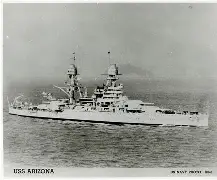
USS Arizona
Hello, welcome to the webpage about the USS Arizona.
USS Arizona was a standard-type battleship built for the United States Navy in the mid-1910s.
Named in honor of the 48th state, she was the second and last ship in the Pennsylvania class.
After being commissioned in 1916, Arizona remained stateside during World War I but escorted President Woodrow Wilson to the subsequent Paris Peace Conference.
The ship was deployed abroad again in 1919 to represent American interests during the Greco-Turkish War.
Two years later, she was transferred to the Pacific Fleet, under which the ship would remain for the rest of her career.
The 1920s and 1930s saw Arizona regularly deployed for training exercises, including the annual Fleet Problems, excluding a comprehensive modernization between 1929 and 1931. The ship supported relief efforts in the wake of a 1933 earthquake near Long Beach, California, and was later filmed for a role in the 1934 James Cagney film Here Comes the Navy before budget cuts led to significant periods in port from 1936 to 1938. In April 1940, the Pacific Fleet's home port was moved from California to Pearl Harbor, Hawaii, as a deterrent to Japanese imperialism.
On 7 December 1941, the Japanese attacked Pearl Harbor, and Arizona was hit by several air-dropped armor-piercing bombs. One detonated an explosive-filled magazine, sinking the battleship and killing 1,177 of its officers and crewmen. Unlike many of the other ships attacked that day, Arizona was so irreparably damaged that it was not repaired for service in World War II. The shipwreck still lies at the bottom of Pearl Harbor beneath the USS Arizona Memorial. Dedicated to all those who died during the attack, the memorial is built across the ship's remains.
Facts
Its arment consisted of
4 × triple 14 in (356 mm) guns
22 × single 5 in (127 mm) guns
4 × single 3 in (76 mm) AA guns
2 × 21 in (533 mm) torpedo tubes
Its armor was
Belt: 13.5–8 in (343–203 mm)
Bulkheads: 13–8 in (330–203 mm)
Barbettes: 13 in (330 mm)
Turrets: 18 in (457 mm)
Decks: 5 in (127 mm)
Conning tower: 16–14 in (406–356 mm)
The Pennsylvania-class ships were significantly larger than their predecessors, the Nevada class. Arizona had an overall length of 608 feet (185.3 m), a beam of 97 feet (29.6 m) (at the waterline), and a draft of 29 feet 3 inches (8.9 m) at deep load. This was 25 feet (7.6 m) longer than the older ships. She displaced 29,158 long tons (29,626 t) at standard and 31,917 long tons (32,429 t) at deep load, over 4,000 long tons (4,060 t) more than the older ships. The ship had a metacentric height of 7.82 feet (2.4 m) at deep load.[2] Her crew numbered 56 officers and 1,031 enlisted men as built.[3]
The ship had four direct-drive Parsons steam turbine sets, each of which drove a propeller 12 feet 1.5 inches (3.7 m) in diameter[4] using steam provided by twelve Babcock & Wilcox boilers.[2] The turbines were designed to produce a total of 34,000 shaft horsepower (25,000 kW), but achieved only 33,376 shp (24,888 kW) during Arizona's sea trials, when she met her designed speed of 21 knots (39 km/h; 24 mph).[5] However, she did manage to reach 21.5 knots (39.8 km/h; 24.7 mph) during a full-power trial in September 1924.[6] She was designed to carry enough fuel oil to steam at a speed of 12 knots (22 km/h; 14 mph) for 8,000 nautical miles (15,000 km; 9,200 mi) with a clean bottom. She had four 300-kilowatt (402 hp) turbo generators.[2]
The main armor deck was three plates thick with a total thickness of 3 inches; over the steering gear the armor increased to 6.25 inches (159 mm) in two plates. Beneath it was the splinter deck that ranged from 1.5 to 2 inches (38 to 51 mm) in thickness.[10] The boiler uptakes were protected by a conical mantlet that ranged from 9 to 15 inches (230 to 380 mm) in thickness.[3] A three-inch torpedo bulkhead was placed 9 feet 6 inches (2.9 m) inboard from the ship's side and the ship was provided with a complete double bottom. Testing in mid-1914 revealed that this system could withstand 300 pounds (140 kg) of TNT.[10]
Construction
The keel of battleship number 39 (hull number: BB-39) was laid on the morning of 16 March 1914 with Assistant Secretary of the Navy Franklin Delano Roosevelt in attendance.[11] The builders intended to set a world-record ten months between the ship's keel-laying and launch,[12] for what The New York Times declared would be "the world's biggest and most powerful, both offensively and defensively, superdreadnought [sic] ever constructed,"[13] but the ship was only a little over half complete a year later.[14] She was launched on 19 June 1915, making it about fifteen months from keel-laying to launch. In the meantime, the ship was named after the newest state in the union by Secretary of the Navy Josephus Daniels.[15]
The New York Times estimated that 75,000 people attended the launch, including John Purroy Mitchel, the mayor of New York City, George W. P. Hunt, the governor of Arizona, and many high-ranking military officials. Several warships were also nearby, including many of the new dreadnoughts which had already entered service (Florida, Utah, Wyoming, Arkansas, New York, and Texas). Esther Ross, the daughter of W. W. Ross of Prescott, Arizona, was given the honors of ship sponsor and christening.[16][17] To acknowledge a ban on alcohol recently passed by the state legislature, the state's governor decided that two bottles would be used: one full of sparkling wine from Ohio, and another filled with water from the Roosevelt Dam. After the launch, Arizona was towed to the Brooklyn Navy Yard for fitting-out.[16]
Arizona was commissioned into the Navy on 17 October 1916 with Captain John McDonald in command.[18] She departed New York on 10 November 1916 after the crew had cleaned the ship and the propulsion system had been tested at the dock.[19] After declinating the ship's magnetic compasses, the ship sailed south for her shakedown cruise. Outside Guantanamo Bay, a stripped turbine on 7 December forced the navy to order Arizona back to New York for repairs, although she was able to enter Chesapeake Bay to test her main and secondary gun batteries on 19–20 December. The turbine could not be repaired inside the ship, so the yard workers had to cut holes in the upper decks to lift the damaged casing out. It was reinstalled after almost four months of repairs at the naval yard.[20]